





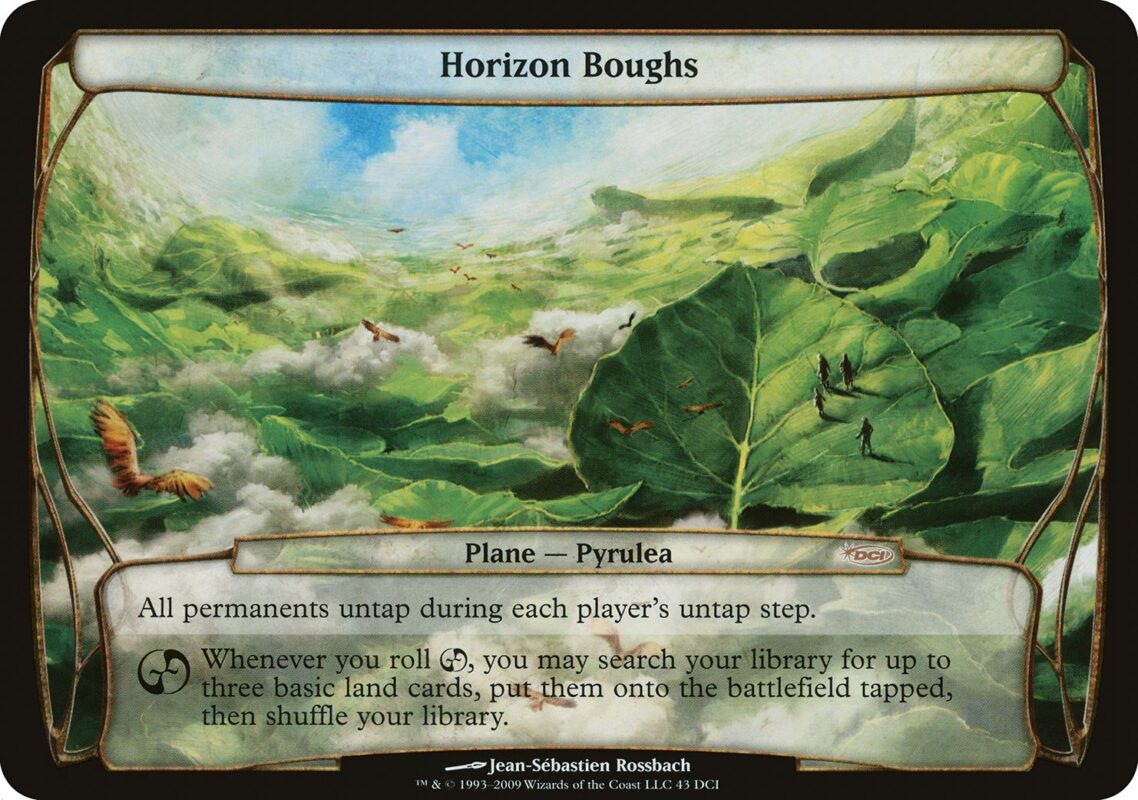
Many of you will now be asking yourselves: “What the hell is Planechase?”. Good that you ask. Planechase was announced in 2009 and was supposed to completely change Magic. It doesn’t seem to have been very successful, as many Magic players aren’t even familiar with “Planechase”.
But now let’s explain how Planechase works and how it differs from “normal Magic”.
What is Planechase?
Planechase is a game variant that simulates a round trip through the multiverse. As you have probably already experienced, there are various worlds in Magic, all of which are characterized by unique living conditions or world forms. Mirrodin, for example, is a metal world, from forests to mountains to grass. Or Zendikar, where the ground and sky are littered with huge mysterious polyhedrons of stone. As a Planeswalker, you use your tools to wander to various worlds where exciting interactions await you.
Each of the unique worlds influences the game and brings new opportunities and dangers.
Preparation:
It is recommended between 3-6 people. However, you can use the standard rules.
-
Minimum 60 card Constructed Deck
-
At least 10 planechase cards
-
One world cube each with Planeswalker and Chaos symbols
Explanation of world maps and phenomena
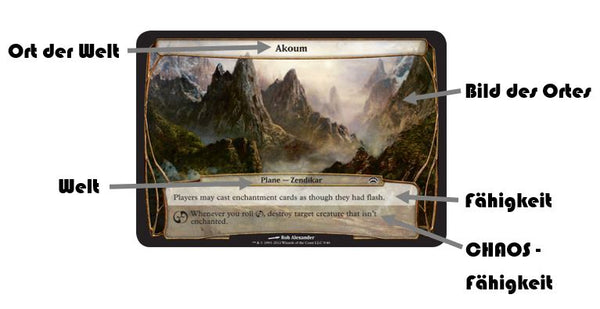
Above you can see a world map with the world of Zendikar. The following applies to these maps:
-
Only one world map is active at any one time.
-
World cards never come into play and are not permanent cards, so they cannot be destroyed or changed in any way.
-
The player whose turn it is is the current ruler.
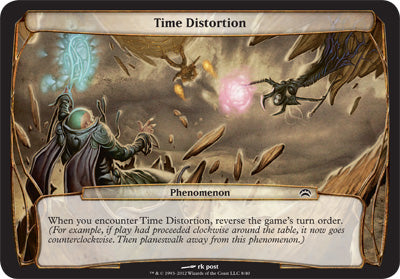
In addition to the world cards, there are also phenomena. If such a card is revealed, the effect of the card takes effect immediately. Once everything has been carried out, the next card in the Planechase deck is revealed. And this is what phenomena look like:
How to play
During your turn, whenever you could play a sorcery, you can roll the world die. You can do this more than once per turn, but then you must pay mana equal to the number of world dice rolls you have already made. So the first roll costs nothing, the second costs any 1 mana, the third costs any 2 mana and so on. The dice roll happens immediately so that nobody can react to it. If the ability of a world card is then triggered by the result of the dice roll, it goes onto the effect stack and is treated just like any other triggered ability, so you can react to it as usual.
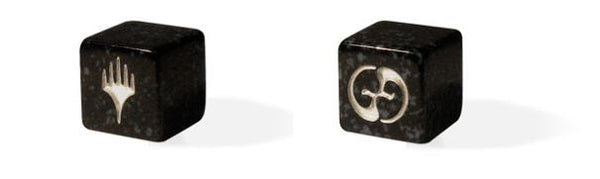
There are three scenarios that follow your dice result:
-
Blank page –> Nothing happens
-
Chaos symbol –> Chaos ability is triggered
-
Planeswalker symbol –> Worldwalking takes effect
How does the game end?
In this area, it is absolutely identical to the usual Magic the Gathering. The standard victory methods apply.
Personal opinion
I’m a huge fan of Planechase myself. Over time, I’ve bought dozens of Planechase cards, which gives me a very varied game. Unfortunately, the downside is also the advantage of the game I just mentioned. It can get very chaotic and it’s hard to keep track of everything. I would therefore advise you to put together your own deck of cards with the Planechase cards you have (or buy). Personally, I favor a weak presence of Phenomenon cards. But if you start to know all the cards because you’ve played it a lot, then unfortunately the format loses its appeal. So don’t overdo it, then you’ll enjoy it for longer 🙂
Nevertheless, I can only recommend this format to everyone. Try it and see how you like it.
 Lego
Lego