





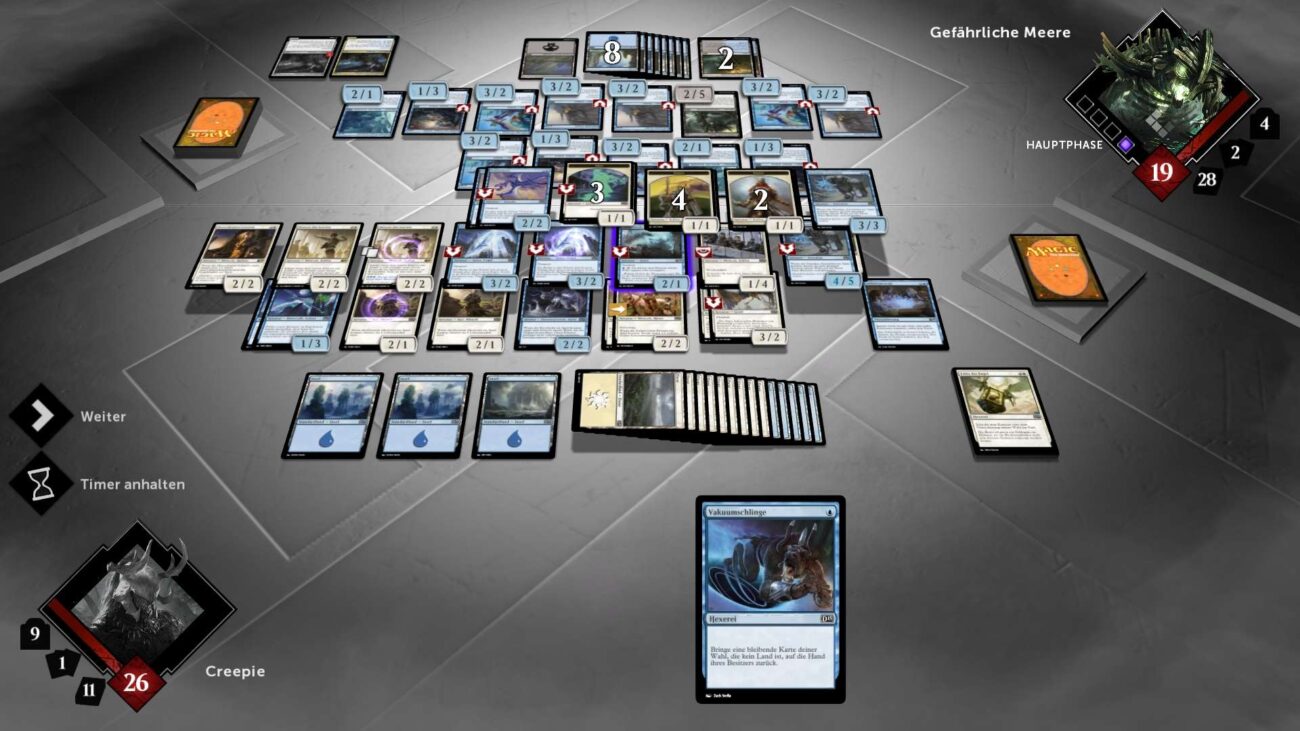
The playing zone, or playing field, is the space between you and your opponent. Each card is in a zone at all times during the game.
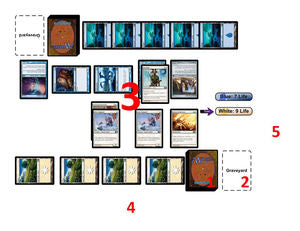
Picture from mtg.fandom
1st library
In the game, the library is represented by your deck, the pile of cards that you put together yourself before the duel. Each card is face down and shuffled in a pile. The deck requires a minimum of 60 cards and is not open at the top (as long as you can still shuffle your deck). At the start of a game, all the cards are here; they are shuffled and placed face down. However, each player can know how many cards are still in a library at any time. Each player has their own library.
2. cemetery
The graveyard is a player’s personal discard pile. Not only neutralized, discarded, destroyed or sacrificed cards end up here, but also creatures that have received fatal damage during the game or whose resistance has dropped to zero or less, as well as Planeswalkers that have lost all their loyalty counters, are placed in the graveyard. Cards in the graveyard are always face up, and each player can look at them at any time. Each player has their own graveyard.
3. playing field
The “game” is referred to as the playing field. Magic cards often say: “When this card comes into play, …..”, which refers to the playing field. At the start of the game, you have nothing in play yet, but this is where most of the action happens later. On each of your turns, you can play a land from your hand. Most cards have to come into play first before an effect occurs. Creatures, artifacts, enchantments and Planeswalkers also come into play after they resolve. You can arrange your permanents however you like, but your opponent must have all cards in view and be able to see whether they are tapped or not.
4th hand
Normally, these cards are only visible to you. However, some cards allow them to be shown. The number of cards in your hand must be known to each player at all times during the game. You usually start the game with seven cards in your hand and each turn you draw another card from the top of your library. At the end of each of your turns, you may only have seven cards in your hand. You must discard any surplus cards. However, this is usually not a problem because you also play cards. Each player has their own hand of cards.
5. exile
If a spell or ability sends a card into exile, it is placed in an area of the game that is separated from the rest of the game. If a card is “exiled”, this means that it goes to the exile pile. The card remains there for the rest of the game unless an effect brings it back. Cards in exile are normally face up and can be seen by everyone. I have simply marked the 5 on the far right, but it doesn’t necessarily have to be there. There could also be another zone in this area, namely the Commander Zone. This zone is only relevant if you also play the Commander format. Otherwise, this zone does not exist for you.
6. stack
This zone is not visible in the image. This stack is not physically visible. You therefore do not need to reserve any space on the playing field for it. Brief explanation of the stack:
The stack is a play zone, just like the field, the graveyard or the hand. When you cast a spell (or activate an ability), it is placed on top of the stack and waits there to be resolved. Spells and abilities only take effect once they have been resolved; nothing happens beforehand.
————————————————————————————————————————
I recommend everyone to adopt the arrangement in the picture above for a strong structure in the game.
Have fun!
 Lego
Lego