






Anyone who swapped Pokémon cards on the playground as a child will remember one thing: nobody actually knew how to play. The only interesting cards were those that effectively depicted Pokémon. But what are these Trainer Trainer cards? And why do you need energy cards in all different colors?
Find out how to play the Pokémon trading card game in this article!
The Pokémon cards
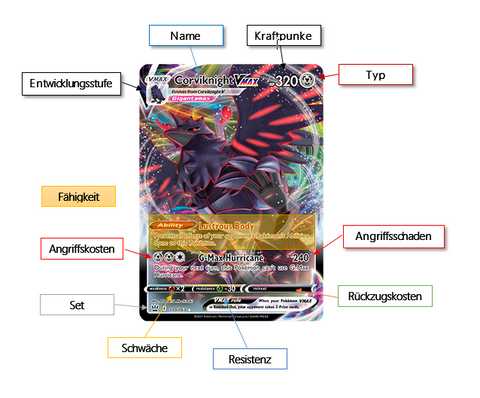
Name: The name of the Pokémon
Power points: The Pokémon’s HP
Type: What type the Pokémon is. In contrast to the video games, however, there are fewer types (Ice Pokémon are usually Water Pokémon, for example)
Evolution Level: The level of the Pokémon. Level 1 Pokémon can be evolved from basic Pokémon, etc.
Ability: Some Pokémon have passive abilities or abilities that can be activated once per turn
Attack cost: The number of Energy cards that must be attached to the Pokémon for an attack (in this example, that would be one Metal Energy and any two).
Attack Damage: The damage dealt to the opposing Trainer’s defending Pokémon
Retreat Cost: The amount of Energy the Pokémon must put into the discard pile to be retired from the active spot.
Resistance: When the Pokémon is attacked by an attacking Pokémon of this type, it takes that much less damage.
Weakness: Damage inflicted by a Pokémon of this type is doubled
Set: The set the card is from (=display, e.g. Kampfstile, Glänzendes Schicksal)
Energy cards
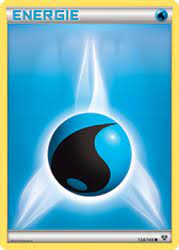
An Energy card can be manually applied to a Pokémon from the hand once per turn. However, there are also abilities on Pokémon, such as Rain Dance, which allow multiple energies to be applied to Pokémon per turn.
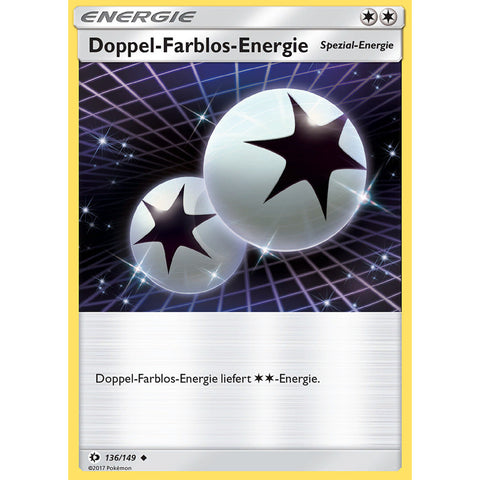
With the energy cards Pokémon can launch their attack as long as the cost is met. Colorless Energy can be covered by any type of Energy. There are also special energies, e.g. the Double Colorless Energy, which provides two Colorless Energies with one attack. This has proven to be very powerful in the past with certain Pokémon such as Zoroark GX
Many attacks require certain combinations of energy cards. It therefore makes sense to build a deck around 1-2 types if possible.
Special energy cards such as Double Colorless Energy may only be included four times in the deck. Basic energy cards, on the other hand, can be played any number of times. In the very strong tournament decks, an average of approx. 8-12 energies are played, depending on the winning strategy of the deck.
Item cards
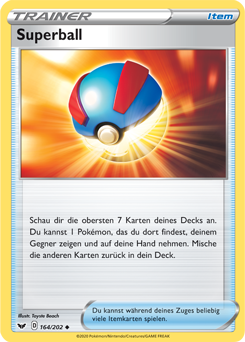
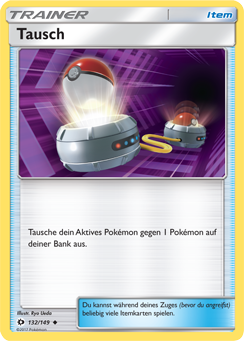
Item cards belong to the trainer cards. A deck may contain a total of four of each trainer card. As many items as the player wishes can be played per turn. These cards often have abilities that heal your Pokémon, strengthen them or search for Pokémon from the deck.
Supporter cards
These cards may only be activated once per turn. Accordingly, they also have much stronger effects than the Item cards. For example, these cards can often draw many cards from the deck or swap Pokémon that are in the bank with the active one, etc.

Stadium tickets
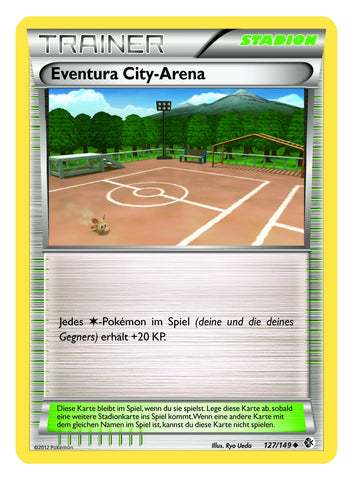
The effects on a stadium apply to both players. In addition, only one stadium may be on the pitch. If a player uses a another stadium, the current stadium disappears into the discard pile. Stadium cards often have passive effects which, for example, strengthen the Pokémon cards of both players if they have a certain type, etc.
Equipment cards
Equipment cards are attached like Energy cards to a Pokémon on the Bench or to the active Pokémon. Equipment cards give the Pokémon to which they are attached new abilities.
The course of the game
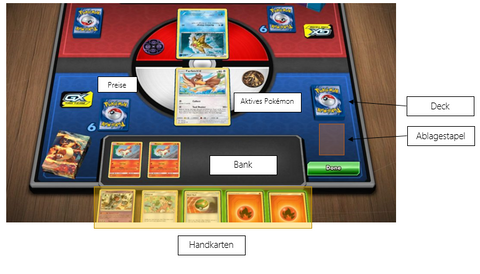
Before explaining the course of a game, the playing field must first be explained. The playing field is quite simple. Each player has a deck from which they can draw a card at the start of each round. On the bench are the Pokémon that are not actively fighting in front. There can be a total of five Pokémon in the bank, unless an ability is active that extends this limit. Pokémon on the bench cannot normally be attacked and are safe from opponents’ attacks. However, there are certain Pokémon and strategies that can damage Pokémon on the Bench. However, the majority of attacks are only ever aimed at the Pokémon that is currently active. Another way to draw Pokémon on the bench into battle is with Trainer cards. There are always items or Supporters that allow you to swap your opponent’s active Pokémon with one on the bench. This can be strategically very valuable, as the opponent can be prevented from building up a strong Pokémon on the bench. The last important part of the playing field are the prize cards. In the online game (from which the picture is taken), this is a stack of six cards. In reality, however, the six prize cards are often fanned out so that you have a better overview of them. Now that the basics are clear, the game can be explained.
Start of the game
First, the deck is shuffled, then the top 7 cards of the deck are taken into the hand. Now both players must place a basic Pokémon face down in the active area. A player who does not have a basic Pokémon shuffles their hand cards back into the deck and draws 7 new cards. This is repeated until both players have a basic Pokémon face down in the active area. For each time a player shuffles back their hand cards, the other player may draw an extra card after both players have placed their active Pokémon.
A throw of the dice or a coin is used to decide who goes first.
Sequence of a train
The player whose turn it is draws a card. Various steps can then be carried out in any order.
- Place any number of basic Pokémon from your hand on the bank
- Any number of Pokémon on the Bench can be evolved (not on the first turn and a Pokémon can only be evolved once per turn)
- An Energy card can be attached to any Pokémon from your hand
- Play support card (one per turn), item or stadium
- Retreat an active Pokémon once (discard Energy on the active Pokémon, equal to the Retreat cost)
- Use skills (any number)
The last action is the battle. The turn player can attack the opponent’s active Pokémon with their active Pokémon.
How does a fight work
Three things are crucial in a fight:
- If the active Pokémon has invested enough Energy to perform the desired attack
- When an attack occurs, the defending Pokémon’s Weakness and Resistance are checked. In the case of resistance, the damage is reduced by the number of resistance points if the attacking Pokémon is of the corresponding type
- Damage counters are placed on the defending Pokémon equal to the attack power of the attack. Dice are usually used as damage counters. In this case, 1 die eye = 1 damage counter = 1 damage. Example: 120 damage would be 12 damage counters. Dice must now be placed on the Pokémon in the amount of 12 eyes (e.g. 2x a six-sided die or the 12 on a 20-sided die, etc.).
This brings us to the end of this short explanatory article. If you have any further questions, please refer to the detailed document on the official website. We hope this article has given new players, parents or simply those interested a good insight into the game!
 Lego
Lego