





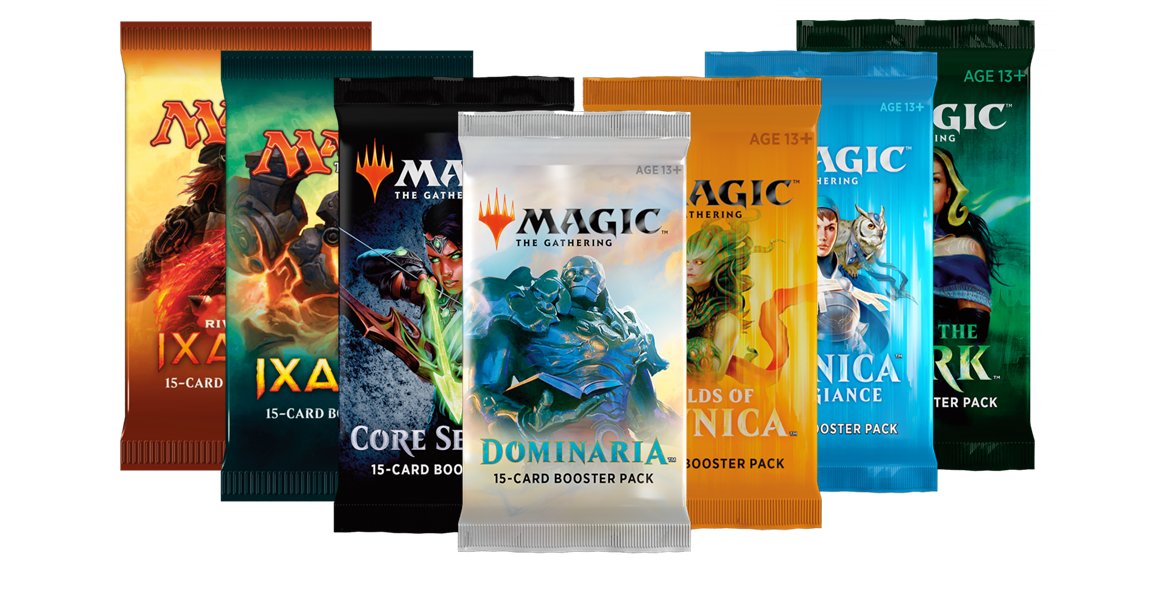
Probably the best-known draft is the Booster Draft. Magic is a game with countless variations. Draft is only the generic term here. Without further ado, let me introduce you to the draft types I know.
Cube Draft
Cube Draft incorporates many of the most fun aspects of Magic and combines elements of the Constructed and Limited formats. One player or the whole group prepares a “cube” – a set of 360 specially selected different Magiccards. Cubes often also have 720 cards to offer a greater choice when drafting. If you want to start with this, you should begin with 360 cards. The cube should contain several synergies of cards with which several strategies can be built. At the beginning, it is also worth looking at existing cube card lists and then rebuilding one of them.
Putting together a cube is a great opportunity to both pull out your favorite cards and experiment with cards you haven’t been able to fit into a Constructed deck yet. The best thing about it is that you can customize everything. Every cube is different.
Once the “cube” is assembled, you can use it for any draft format. The most popular variant is to randomly split the shuffled cards into 15-card booster packs and use them to create a normal booster draft from it. We always took some empty booster packs and filled them with these cards. Put the cards in, close them with glue and a Booster is ready.
Reject Rare-Draft
Each player donates 45 rare cards from their collection. These cards are shuffled together and combined into booster packs of 15 cards. And then these boosters are used for a normal booster draft is played with these boosters. The normal Limited rules apply.
A Reject Rare draft is a great opportunity to try out cards that are never or almost never played in most Constructed formats. Even for experienced Limited players, this format has something new to offer, as the common and not-so-common cards are usually the most important in Limited.
At the end, everyone has 45 rare cards again. You can decide for yourselves whether these are the same as at the start or whether each player goes home with new cards. However, the attraction increases with the change of ownership.
Winston draft
The Winston draft is played in pairs. Each player opens three booster packs without looking at the contents. You shuffle all six packs together to create a stock of ninety cards. Roll the dice to determine which of you is “Player A” and which is “Player B”. Player A has the first turn in the draft, but Player B can decide before all games whether he wants to go first.
Player A starts the draft by placing the top three cards of the card stock face down next to each other on the table, forming the basis of the three draft piles. He does not look at the cards.
Player A looks at the card in the first pile without showing it to player B and then decides whether to discard it or put it back. If player A draws the pile, it is topped up (again face down) with the top card of the stock and it is player B’s turn. If player A puts the card back, the top card of the stock is placed on top, so that there are now two cards in the first pile. Player A then repeats the process with the second pile and possibly also with the third. If player A has not taken any of the three piles, he must take the top card of the stock pile, regardless of what it is. As soon as player A has drafted one of the piles or drawn the top card of the stock, it is player B’s turn to do exactly the same.
If a player takes a pile, it is replaced by the top card of the stock, so that the pile has exactly one card again. And whenever a player puts a pile back, it is replaced by the top card of the stock. There is no limit to the height of the pile.
Both players then put together a deck according to the normal Limited rules. As in every draft, standard lands are made available from the outside.
Chaos Draft
The Chaos Draft is my favorite form of draft. Very simple and easy to implement. The function is 1 to 1 the same as in the Booster Draft with one exception: each booster set is only available once. For example, if you are 8 people, 24 Boosters are needed so that everyone has 3 Booster Packs. Imagine that everyone has completely different Booster Packs from various series of Magic that have been released over the years. You can find Choas-Draft products HERE. I recommend that you build something that you can reach into. I took an old shoe box and cut a hole in it. One by one, you reach in with your hand and pull out a Booster. Nobody knows which Booster Pack they will receive.
Rotisserie draft
Preparing a Rotisserie Draft takes a little longer, but this format offers a completely new draft experience in the Limited area. What’s particularly interesting is that all the rare cards in the set are in the draft and suddenly appear just as often as the cards that are actually common! In addition, you can always keep track of which cards are still in the draft and which strategies your opponents choose when drafting. You need 1-2 complete Magic the Gathering sets (each card 1x) and the number of players should be chosen so that the total number of cards divided by the number of players is between 40 and 50.
The cards are sorted by collector number (alphabetically by color for older sets without a collector number) and laid out face up on the table. The players then roll the dice to determine the order in which they will take their turn in the draft. The first drafter chooses one of the cards and places it face down in front of them. Then the other players take their turn one after the other until everyone has taken a card. Now the draft order is reversed: the player who took the last card takes his second card, then the penultimate player and so on. When it is the original starting player’s turn again, he takes two cards, and so on. Example: If four players are involved in the draft (A, B, C and D), the draft order is A, B, C, D, then D, C, B, A, then A, B, C, D again. Drafting continues until all cards have been taken.
Everyone builds their deck according to the Limited rules. Here, too, the Standard lands must be accessible from the outside.
Continuous draft
This draft is not based on a round principle but can last as long as you like.
At the start of the draft, each player opens three booster packs and chooses a card to keep out of the draft. He then chooses another player with 44 cards to draft. After drawing lots to determine who drafts first, the players shuffle their 88 cards together. Player A turns over the top four cards and takes one of them. Then player B chooses two cards for himself and player A takes the remaining card. For the next four cards, player B chooses first, and this continues in turn until all the cards have been drafted. The players then put together their decks with at least 40 cards, adding as many standard lands (plains, islands, swamps, mountains and forests) as they want, and start playing.
The first player to win two out of three matches is the winner. As soon as a player has finished a match, they sort out the Standard lands they have added (to get back to 44 cards), look for a new opponent and start a new draft with them. Your card stock will change with every duel, so you will always have new draft decks to play with.
Solomon draft
The Solomon draft is a unique variant of the booster draft format for exactly two Magic players. Each player needs three booster packs, which are opened without looking at the contents. You shuffle all six packs together to create a stock of ninety cards. Then the draft begins.
Roll the dice to determine which of you is “Player A” and which is “Player B”. Player A has the first turn in the draft, but Player B can decide before all games whether he wants to go first. In the draft, player A reveals the first eight cards of the stock and divides them into two piles. These can be two piles of the same size with four cards each, but they can also be piles of different sizes: five and three cards, six and two, seven and one or even eight and zero.
After player A has split the cards, player B takes one of these piles and adds it to his drafted cards. The other pile goes to player A. The process is then repeated, but this time player B splits the next eight cards and player A chooses one of the piles. This goes back and forth: one player puts the piles together, the other selects until all the cards have been drafted. (The last group then contains ten cards instead of eight.) Both players use their drafted cards to build a deck with at least 40 cards, whereby they can add as many standard lands (plains, islands, swamps, mountains and forests) as they want.
Many players like the Solomon draft because it challenges them in a different way than a traditional booster draft. Instead of always picking a single card from a single pack, each player has to figure out what colors their opponent is likely to play. It’s not easy to find the balance of balancing good cards against middling cards in the pile so that you end up with the cards you want, and you shouldn’t lose track of which cards have already been drafted into which deck. A Solomon draft is a great variant if you want to draft in pairs.
Booster duel
This is not actually a draft variant, but I wanted to mention it briefly anyway.
Do you know the situation? You and your friends have just bought some booster packs. You’re planning to open them up and enjoy the contents. But stop – why don’t you play a little Magic while you open your packs?
Each player opens a Booster and the entire Booster becomes their starting hand! During their turn, each player may take a land from a common supply outside the game and bring it into play. The game is played without a library, you can’t draw cards and you don’t lose if you can’t draw a card. Do you want to play with 10, 20 or more life points? Decide the other rules for yourself.
————————————————————————————————————
I hope you’ve now got some new ideas and your head has started to dream a little. Which version will you try first?
 Lego
Lego