






-
Deckbuilder Toolkits (These help you to create a deck from scratch.
-
Deck ideas from the Internet
-
Finished Deck (Planeswalker Decks, Challenger Decks, Commander Decks etc.)
A deck consists of at least 60 cards, but preferably no more than 60, as otherwise the probability of drawing a particular card is reduced. Of the 60 cards, there should be around 23-24 lands; with predominantly “cheap” spells in the deck up to three less, with many mana-hungry spells there should be more lands. Each card may appear a maximum of four times in the deck. The exceptions here are standard lands Plain, Island, Swamp, Mountain, Forest, where there is no maximum.
Strategy and color
First of all, think about how you want to win! With a few big creatures or lots of small ones? Should the deck support a certain card combination? To build an efficient deck, you first need a strategy! That’s why I recommend that you first decide on a strategy.
Once you have a strategy in place, it’s time to choose the color(s). For simplicity’s sake, mono-colored decks are appropriate. Mono decks or single-color decks only consist of cards of one color and colorless spells (artifacts) and have the advantage of always having the right mana at hand. On the other hand, they are easier to counter. The weakness of playing with only one color is obvious. You are limited to one color’s effect principle and therefore have fewer options to react to your opponent’s deck. Multicolored decks are usually more flexible, but carry the risk of not having the right mana available to play a certain spell – especially if the spell requires a lot of colored mana. The more colors you have in your deck, the greater this risk, so it is advisable to limit yourself to two or at most three deck colors at first.
Country and cover structure
The easiest way to determine the distribution of lands in multicolored decks is to determine the ratio of mana symbols in the mana costs of all cards. For example, if you count 30 blue and 18 green mana symbols, you could divide the 24 lands into 15 Islands and 9 Forests. Or calculate down to roughly the same ratio.
One thing is clear: the more cards the deck contains and the rarer a particular card appears in it, the less likely it is to get this card into your hand during the game.
Which cards fit into the deck depends on how you want to win the game. A few big creatures that smash everything to bits? an army of small ones that overrun the opponent? a combination of cards that decide the game immediately?
There are endless possibilities here and that’s what makes the game so interesting.
The cards should have a good price-performance ratio (between mana cost and effect). A creature that costs 2 mana to play and has 2/2 is not bad. If another creature had the trait trample or flying it would be better, because it is more difficult to block by the opponent. The deck should also include cards with different mana costs. With 1, 2, 3, 4 mana, so that you can play a 1 spell at the start of a game! If the game lasts several rounds, powerful creatures are of course very helpful. Although these usually cost a lot of mana, they often decide a game in the late game phase. However, expensive cards are useless if your opponent is faster and you can’t play them because their mana costs are too high. It is important to find the right balance in the deck. As with the colors, the same applies here: If you concentrate on one winning option, this increases the chance of being able to realize it if almost all the cards in the deck follow the same strategy. However, it is not wrong to also consider a second winning option. Basically, the faster you want to win with a deck, the more you should focus on one direction. If, on the other hand, you want to slow down your opponent’s play and stall him in order to slowly but surely gain control of the game or build up a combo, then you can implement alternative winning scenarios.
You should keep in mind that your opponent will try to thwart your strategy. In the best case scenario, they will have cards in their deck that will thwart you, so you should definitely have problem solvers in your deck. Since we just talked about problem solvers, now is a good time to talk about the sideboard. There are 15 more cards in there to customize the deck against opponents and other decks. The cards from the sideboard can be exchanged between games. This is where you put cards to improve your deck against certain opponent strategies or even to confuse your opponent with a completely different game strategy!
Advantages and disadvantages of the colors
In Magic, the 5 different colors are differently good or bad against certain card types. For example, green is almost impossible to directly destroy a creature with a spell.
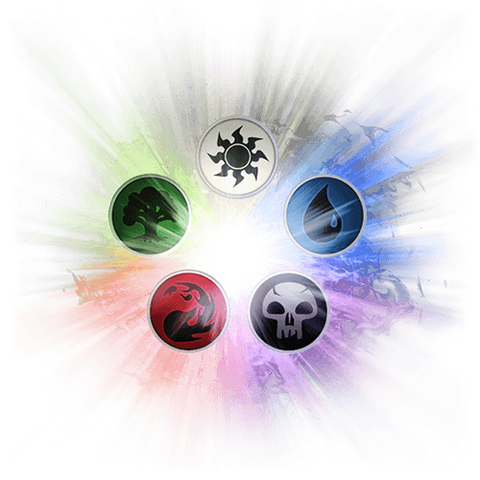
White has many spells that can be used to destroy enchantments and artifacts, prevent damage and gain life points. Creatures can be prevented from attacking or otherwise disrupting in a variety of ways.
Black has the option of destroying creatures or sending them to the graveyard by removing their resistance. You can also use Black to make your opponent discard cards from their hand and “drain” life points from them.
Red is the color for direct damage to creatures and players and allows the destruction of artifacts and lands. Very temp-heavy.
Green can dispose of artifacts and enchantments and deal damage to flying creatures. There are also a particularly large number of creatures in this color that can produce mana, as well as spells that can be used to search for lands from the library and, in some cases, bring them directly into play.
Blue is good for neutralizing spells of all kinds and sending creatures and other permanents back to your hand. Drawing cards is also rarely a problem.
Conclusion:
To continuously improve the deck: play, play and play again!
I usually build my decks around a few cards or even a single card as inspiration. These are cards that I particularly like or that challenge me in some way. I have to say though that these decks can’t compete with tournament decks and are built more “just for fun” 🙂
I wish you lots of fun trying out your deck.
 Lego
Lego